Micro Macro started as a personal exploration of working with audio buffers in Max for Live. For a series of recordings I needed ways to manipulate and corrupt audio inside Ableton in real time.
My main reference was the Data Bender by Qu-Bit, a Eurorack module I have been using in almost every one of my patches in one way or another. Micro Macro is my take on it in Max for Live.
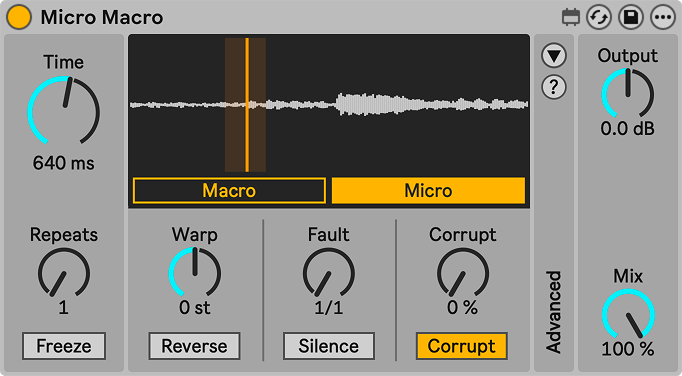
There are two modes, Micro and Macro, named after the Data Bender’s own. In Micro you manipulate speed and position yourself. Macro adds random changes to speed and position on each clock pulse. I chose them as the device’s name, a nod to Mikro Makro by Alva Noto and Mika Vainio.
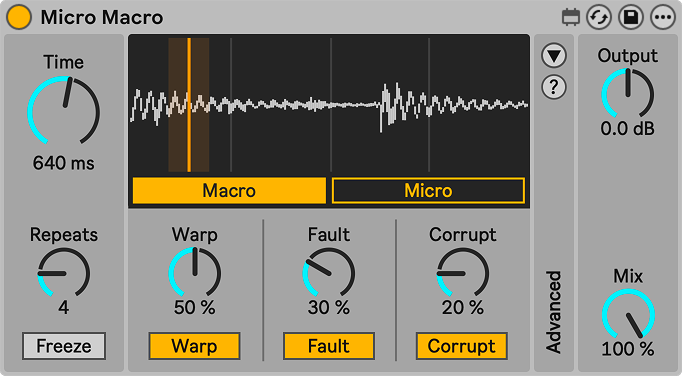
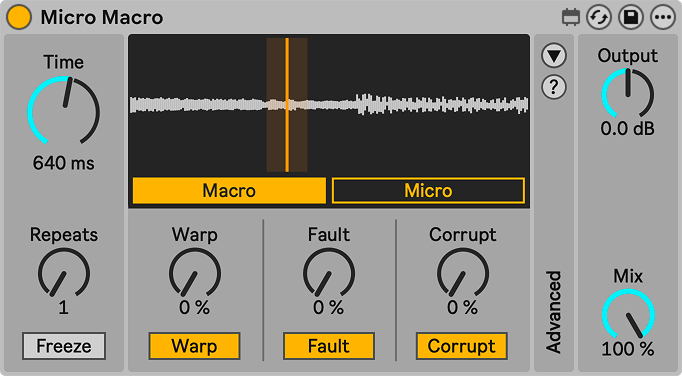
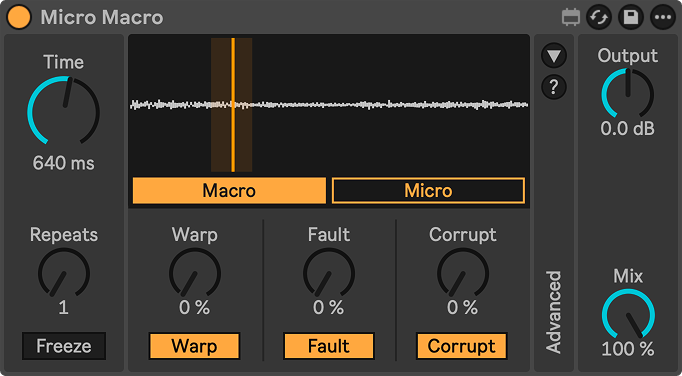
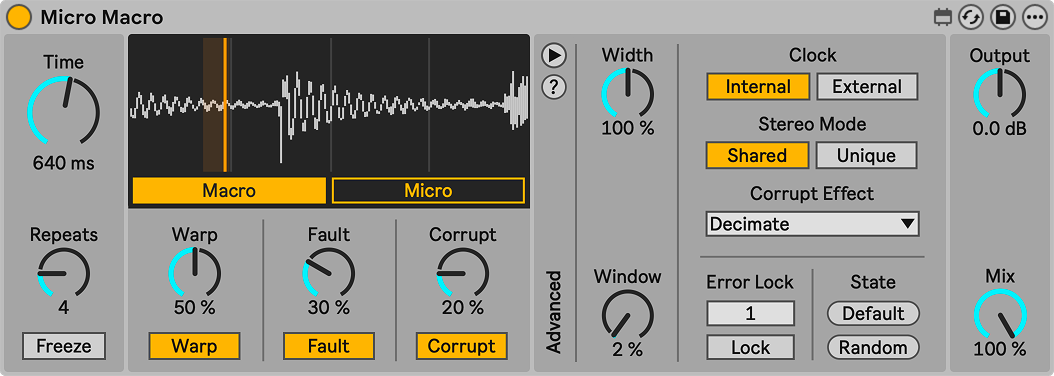
Incoming audio is written continuously into a stereo buffer, and what you hear is a section of it, its length set by Time. Repeats further cuts that section into up to 16 subsections and repeats one. Warp and Fault add ways to manipulate the playheads, and Corrupt degrades the result at the end of the chain.
Time
Sets the length of the section you hear, from 12.5 ms to 16 seconds, and how fast the clock runs.
Repeats
Cuts the section into 1 to 16 parts and loops one. At short Time settings the repeats turn into a pitched tone.
Warp
Changes speed, pitch and direction. Low settings give rare, mild changes, high settings frequent, severe ones.
Fault
Moves the playhead between the parts, cuts them up and silences them.
Corrupt
Sets how much of the chosen effect is applied at the end of the chain. Decimate lowers the sample rate and bit depth. Dropout cuts the sound in and out. Destroy overdrives it. Collapse turns it into a failing Bluetooth link.
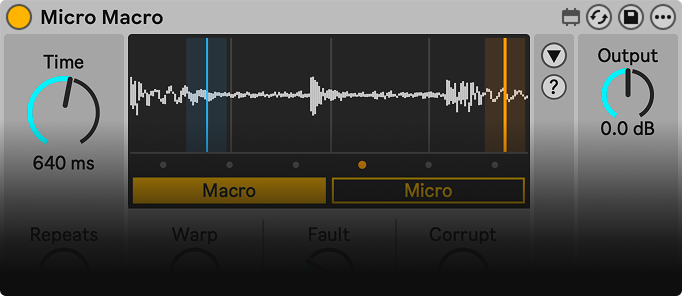
Error Lock
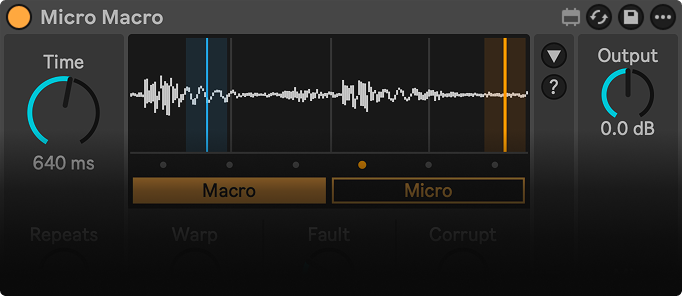
Stops new errors and loops up to 16 of the most recent ones. Steps sets how many of the 16 play back, also adjustable after locking.
Stereo Mode
Unique gives each channel its own playhead, so left and right break up differently. Shared keeps them together for a centred, mono-compatible sound.
Width
Sets the stereo width of the processed signal, from 0 to 200%. It has the most effect with Stereo Mode on Unique.
Clock
Runs from Time, or follows Live’s tempo with a dial from eight times faster to sixteen times slower.
Random
Randomises the sound-shaping dials for the current mode. In Macro the device then breaks the sound on its own, like faulty equipment.
Freeze captures the current buffer section and loops it. But I also wanted a way to capture the device’s error events so I added Error Lock. It stops the device from creating new error events and replays up to 16 of the most recent ones in a loop. With the buffer still live you hear the same glitch pattern over fresh audio. Together with Freeze you get a fixed loop of both audio and errors.
At the end of the chain, Corrupt degrades the sound with bitcrushing, audio dropouts or distortion. The fourth option is Collapse, its effect taken from a device I built that simulates a failing Bluetooth link. As the signal weakens, the sound loses detail across its frequencies and breaks up into spectral errors.
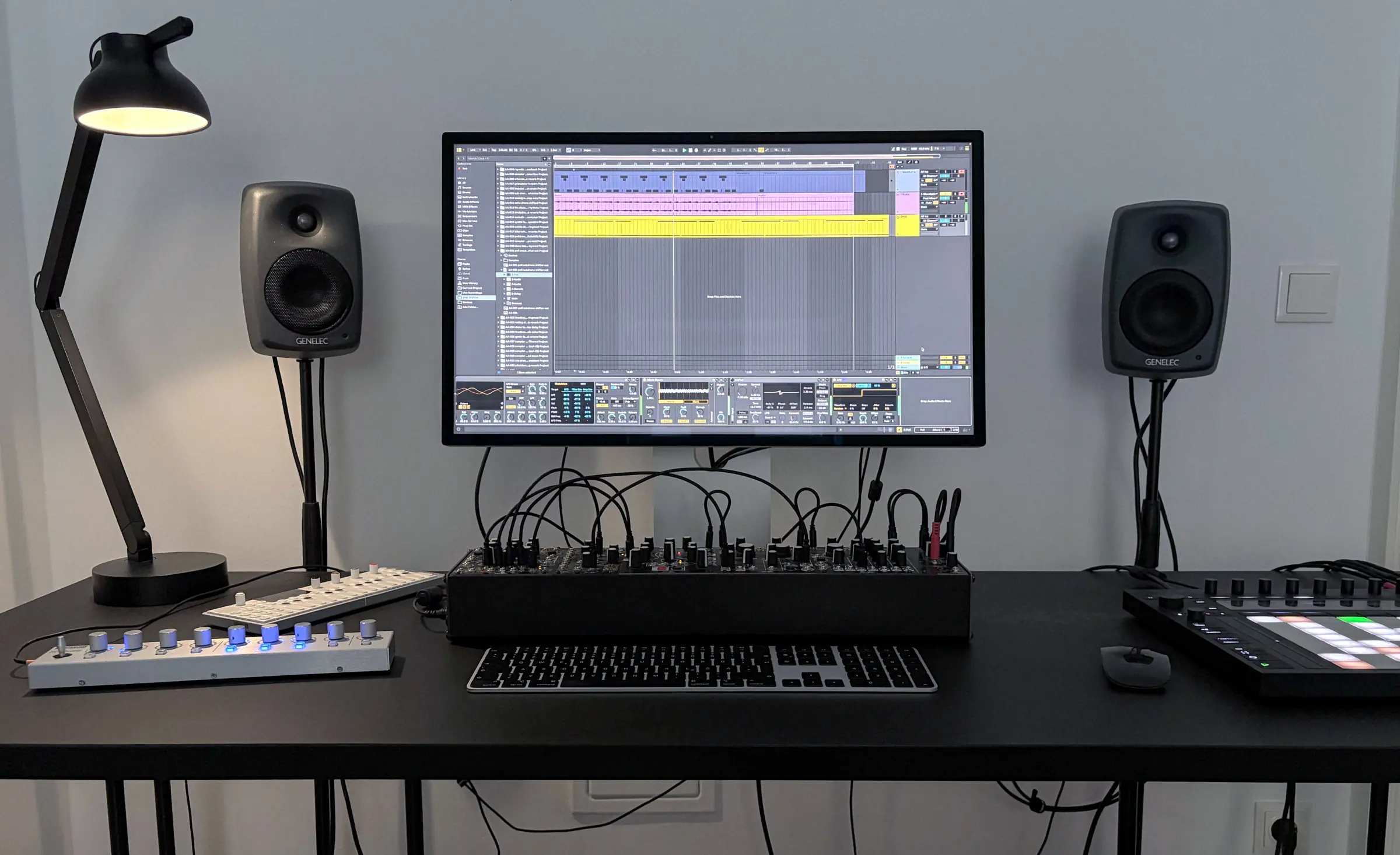
I built Micro Macro between April and October 2026. I made it for my own music, and hope you find it useful as well.
Requirements
Tested in Ableton Live 12 Suite.
Might work in earlier versions.
Contents
15 Presets, 1 Max Device
Optional
Ableton Push 2 or 3
Support
Free to download and use. If you find a bug or have a question, let me know.