Collapse started as a personal exploration of digital errors and degradation of wireless audio signals. It simulates a Bluetooth link failing as you move away from the source.
Since AirPods are my everyday headphones, I hear these errors regularly when walking out of range. The way the audio corrupts, gains texture and breaks up, and what that adds to the material, has always intrigued me. Collapse aims to recreate the tonal changes and behaviour of the Bluetooth codecs in Max for Live.
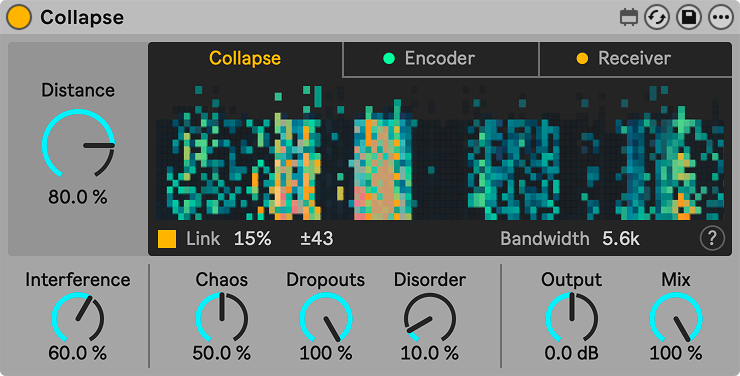
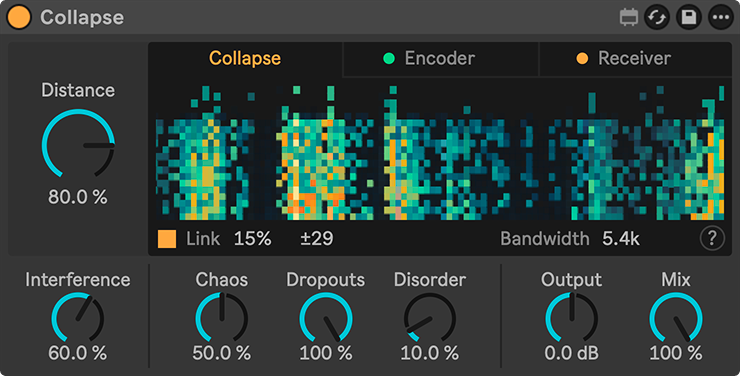
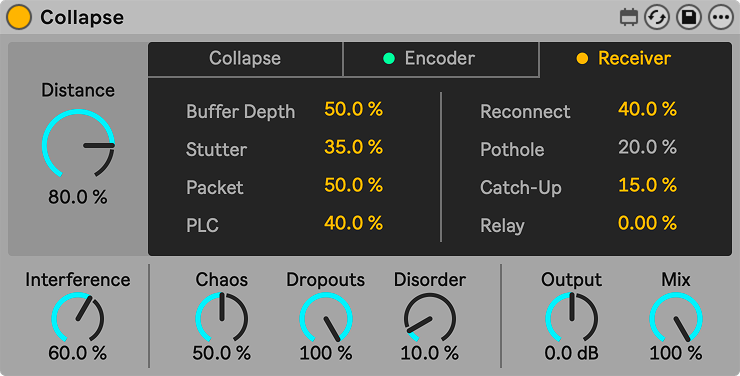
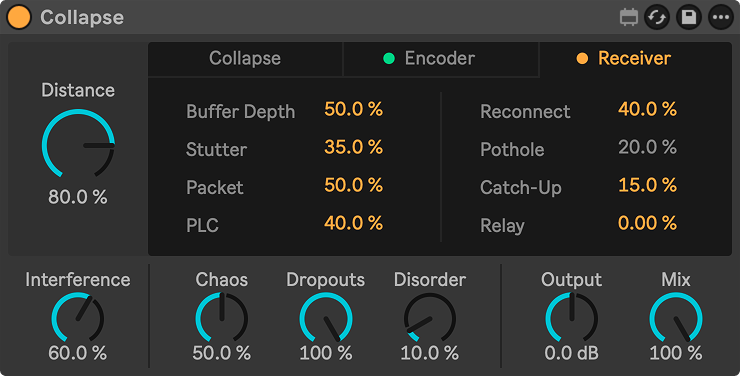
The main control is Distance, how far you have walked from the source. It doesn’t affect the audio itself but sets how well the link holds. Below it the device layers two kinds of failure. The Encoder fails in tone, the way a codec loses detail when its data rate drops. The Receiver fails in time. Bluetooth sends audio in small packets, and some arrive late or not at all. As Distance rises, the tone degrades further and the link fails more often.
The Encoder has three codecs, SBC, AAC and LC3, each modelled on the real codec’s characteristics. A codec doesn’t encode the sound continuously but in short pieces, called frames, and compresses each one separately. SBC is gritty and dark and loses the most treble, AAC is balanced but adds pre-echo, and LC3 stays smooth and keeps the most detail. The Encoder’s fine-tune controls set how far the treble closes, the bass thins, the bit depth drops and the stereo narrows at full Distance. The Receiver and its controls set when failures start, how long they last, and what fills the gaps, a repeat, a fading copy or silence.
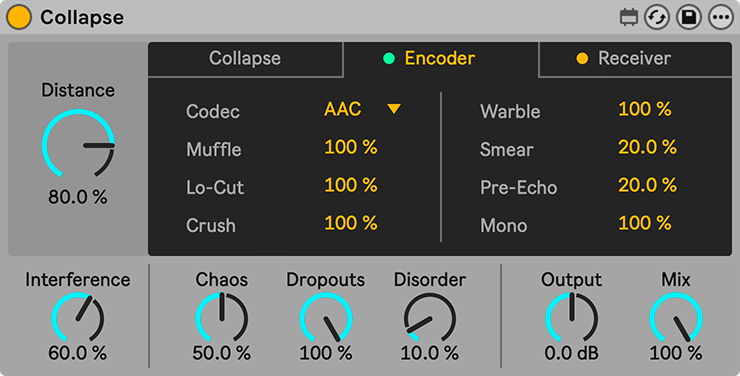
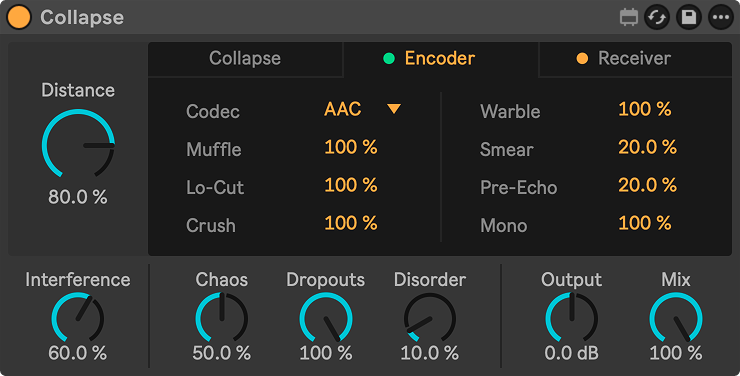
Crush
When a codec is short of data, the sound loses bit depth. In Collapse, bass and mids drop to 5 bits on SBC, 6 on AAC and 7 on LC3, and the highs can drop even further.
Warble
The codec leaves out quiet details from the spectrum, and which ones it leaves out changes every frame. The highs flicker in and out, most audibly on cymbals and reverb tails.
Smear
Adds short metallic whistles in the highs, the stray tones an encoder produces at low data rates.
Pre-Echo
AAC works in long frames, so the noise around a sharp attack spreads into the moment before it. Collapse captures each attack and plays a quiet, reversed copy just before it.
Mono
When the link weakens, the stereo image narrows toward mono. On AAC the highs turn mono first while the bass keeps its width, because the codec stops coding stereo in the upper bands.
Stutter
When the receiver’s buffer runs empty for a moment, the last piece of audio repeats. The weaker the link gets, the more often you hear silence instead, as in real earbuds.
Reconnect
Sets how dark and coarse the sound returns after a disconnect. A real link restarts at its lowest quality and steps back up.
Pothole
On LC3 a short loss is covered instead of lost. There is no gap, but the sound narrows and roughens for a moment, then recovers.
Catch-Up
Audio delayed by a dropout waits in the receiver’s buffer. When the link returns, it plays back faster until it has caught up, and the pitch rises briefly. If it falls too far behind, it skips forward.
Relay
In older earbuds the signal reaches one bud through the other, so one ear tends to fail first and harder. Relay sets which ear. Relay doesn’t apply to LC3, where each bud has its own link.
Collapse behaves like a real Bluetooth link. It fails in bursts with calm stretches between, and each channel can fail on its own. Chaos sets how the failures spread, evenly at 0 and in sudden bursts at the top.
A supervision timer counts up while packets are lost and down while they arrive. At its limit, the link disconnects and the sound cuts to silence. In addition to the link’s own dropouts, Interference can add dropouts from another source on the same 2.4 GHz band, where the two signals collide, even at Distance 0%.
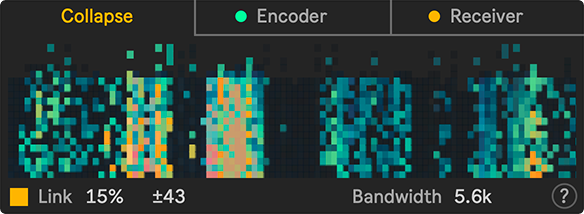
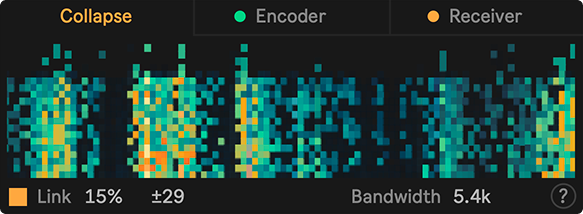
The visualiser isn’t a spectrum analyser. There is no FFT. Instead, the gen~ engine passes its own state to the display 30 times a second, and each update adds a column, covering the last 3.3 seconds. Because it shows what the device is doing rather than what comes out, it can tell a dropout from a stutter.
I built Collapse between June and October 2026. I made it for my own music, and hope you find it useful as well.
Requirements
Tested in Ableton Live 12 Suite.
Might work in earlier versions.
Contents
17 Presets, 1 Max Device
Optional
Ableton Push 2 or 3
Support
Free to download and use. If you find a bug or have a question, let me know.